Showing posts with label Good Healthy Food. Show all posts

Monday, 18 February 2013

Homemade Toasted Muesli

Honestly, since I have learned to make my own toasted muesli and discovered how tasty it is and how easy it is to make, I will never buy packaged cereal again.


This is a really healthy (and OMS friendly) way to start the day.

Ingredients
4 cups wholegrain rolled oats (I use Lowmans)
1 cup of mixed nuts and seeds*
1 cup dried fruit*
120 ml (6 tbsp) maple syrup, runny honey or agave nectar
40 ml (2 tbsp) extra-virgin olive oil


Method

Place the rolled oats, maple syrup and olive oil into a bowl and toss to combine.

Spread the mixture onto 2 baking trays lined with parchment paper.

Bake in the oven at 180C/350F  or  160C/320F fan forced for 5-7 minutes.

Roughly chop the nuts and add them to the oats, giving them a good stir to ensure they brown evenly.  Cook for another 5-10 minutes.  All ovens vary, so just keep an eye on it.  Burnt oats and nuts taste terrible.  Remove the trays from the oven and allow the mixture to cool.


Add the dried fruit to the oat and nut mixture, and thoroughly mix.


I store my toasted muesli in an air-tight plastic cereal container.  It will last a few weeks, but I usually eat it all before then.


Notes & Variations:
This is a really flexible recipe.  You can easily adapt it to suit your own taste.
Apart from oats, you can also add rolled rice, or unprocessed wheat bran.
Nuts & Seeds
Use any mix of the following:

  • cashews
  • almonds
  • hazelnuts
  • walnuts
  • brazil nuts
  • macadamias
  • pecan nuts
  • pepitas (pumpkin seeds)
  • poppy seeds
  • sesame seeds
Dried Fruit
Use any mix of the following:
  • raisins
  • sultanas (buy the natural ones without added oil)
  • currants
  • craisins (dried cranberries)
  • chopped dried apricots
  • chopped dried apple or mango
  • chopped dried fig
  • goji berries
Extras
You can sprinkle over chia seeds or ground flax seeds at the time of serving.  Add a dollop of yoghurt (I make my own soy yoghurt), or add fresh fruit.
If you want some extra spice, you can add a sprinkle of cinnamon to the oats when you toast them.

I find a ratio of 4 parts oats, 1 part nuts and seeds, and 1 part dried fruit works for me.  You may wish to make it heavier or lighter.

I also find that 120ml of maple syrup is sweet enough for me, but you may choose to use more or less.  If you use agave nectar, reduce the amount slightly.  If you use honey, a runny honey is best.

Interesting Facts

I would call this Granola, but the name 'Granola' is trademarked in Australia and New Zealand by Sanitarium.  Granola is just rolled oats, nuts and honey that have been baked as a breakfast cereal, but only Sanitarium can all it that, so let's call this toasted muesli.

A friend of mine who has spent a number of holidays in Switzerland told me that the cereal aisle of the supermarkets there are completely different to ours.  There are virtually no pre-packaged cereals in boxes.  Instead the aisle is filled with all the ingredients people need to make their own muesli.  Interesting huh?

If you've never made your own muesli before, I urge you to give it a try.  It's also a great way to use up all the left over dried fruit that I used to make my OMS Christmas Pudding.


post signature

Monday, 4 February 2013

Spaghetti with Clams and Mussels

The other week, I shared my Spanish Seafood Paella recipe with you.  When I buy the pot-ready mussels and clams for the paella, I buy them in a vacuum packed 1kg bag, and there are more in the pack than I need for the paella which means the night after paella is clam and mussel spaghetti night.


Spaghetti Vongole is spaghetti with clams.  You can also make this dish just with mussels, but I made it with both as I had them left over and didn't want to waste them.

Ingredients  (serves 4)
500+ grams baby clams (vongole, pippis)
500+ grams pot-ready mussels
300-400 grams spaghetti (wholemeal preferable)
1/2 cup 125ml dry white wine (or use water or stock)
2-3 cloves garlic, crushed
3 tomatoes, peeled, de-seeded and diced
1 small red chilli,  seeded and finely diced (optional)
Extra-virgin olive oil (EVOO)
2 tablespoons chopped parsley
salt, pepper and lemon wedges to serve


Method

Prepare your clams and mussels.  I usually soak the clams in cool salted water for an hour, then rinse and drain.  The mussels are pot-ready and can go straight in.  Discard any that do not close when tapped.


Bring a large saucepan of salted water to a rapid boil, then add the spaghetti.  Cook for the recommended time with the water constantly at a rolling boil.  Set the timer - mine usually takes 11-12 minutes.  I'd run out of wholemeal, so used normal white spaghetti.


While the pasta is cooking, gently heat a small amount of EVOO in a non-stick fry pan, and  sweat the garlic for a couple of minutes.  Add the wine and turn up the heat.

With about 4-5 minutes to go on the pasta, add the clams to the fry pan and cover with a lid. Shake the pan from time to time.


With 3-4 minutes to go on the pasta, add the mussels to the fry pan and cover with a lid.


When the pasta is cooked, drain it.  Now you can either add the spaghetti to the pan with the mussels and clams, or if you are worried the clams have left some sand/grit in the cooking liquid, put the pasta back in the saucepan and add the mussels and clams to the pasta, then pour over some strained cooking liquid.  Toss through the tomatoes and chilli and season with salt and pepper.  Discard and clams or mussels that do not open.  Serve with lemon wedges.


It is good to have some crusty bread on hand to soak up all the juices.


Notes & Variations
You can also add diced zucchini (courgette) to increase the vegetables.
You can make it just with clams (vongole), just with mussels, or with both.
If I don't have any chillis, I use Chilli infused EVOO and drizzle it over at the end.
The quantities I've given are a rough guide.  Adjust them to suit your needs and tastes.
You can replace the tomatoes with tinned tomatoes if you want more of a tomato base, or you can leave the tomatoes out entirely and just use the wine and garlic.
To make the classic Moules Marinieres just steam the mussels as above, replacing the garlic with a couple of French shallots, diced, and add some thyme and a bay leaf. Serve with crusty bread or oven-baked fries instead of pasta.  You can also steam mussels in beer, like they do in Belgium.

Mussels in Brussels - well, it's actually Brugge in Belguim - June 2009


To learn how to purge (remove sand from) clams and mussels see the Sydney Fish Markets web site here.

Interesting Facts
Vongole is Italian for clams.
In Italy Parmesan cheese is never added to seafood.  It just isn't done.
Mussels need to steam rather than boil, so don't add to much liquid to the pan.  The mussels release their own liquid when they open which adds flavour to the dish.

post signature

Monday, 21 January 2013

My Borough Market Seafood Paella


Whilst living in London, my family were fortunate enough to visit Spain where we ate the famous Spanish dish of paella several times.  Keen to recreate the dish when we returned to London, we headed to the Borough Markets where we bought a traditional paella pan and all the ingredients we needed to make our version of the dish.


Now I am not Spanish, and make no claims that this is an authentic or traditional dish.  It is just my version of the dish inspired by my trips to Spain, and by the wonderful produce available at the Borough markets, that I sadly no longer have access to.

Ingredients (for a 6 person pan)
Sofrito
1 Spanish onion, diced
2 cloves of garlic, chopped
2-3 tomatoes, peeled, de-seeded and chopped
6 piquillo or piquante peppers (from jar, drained and chopped) or 1 red capsicum, diced
2 teaspoons extra-virgin olive oil (EVOO)
Rice
1 1/2 cups Calasperra or Bomba, Spanish paella rice
3 cups (750ml) stock - fish or vegetable
100ml dry white wine (optional)
Seafood & Vegetables
You can use any mix of seafood you like, I used:
12 live clams (pippis, vongole)
12 pot-ready live mussels
1-2 tubes of calamari, cleaned and cut into strips
12 green prawns, peeled and de-vained with tails intact
a handful of green beans (or peas if you prefer)
Seasoning
1 tablespoon pimento (Spanish smoked paprika)
a pinch of saffron threads (1 teaspoon)
2-3 lemons cut into wedges
handful of parsley, chopped
salt flakes & freshly cracked black pepper

Preparation


  • Get all of your ingredients together.
  • Prepare your seafood.  I buy pot-ready clams and mussels, so they don't need much preparation.  I soak the clams in cold salted water for an hour or so, then rinse them just to remove any remaining sand or grit in them.  If your mussels aren't pot ready, you will need to scrub them and remove beards.  Discard any open mussels that don't close when tapped.
  • Blanch the green beans - I put them in a pyrex bowl, boil the kettle, pour boiling water into the bowl and leave for 10 seconds, then I drain the beans and run them under cold water.  Blanching the beans just keeps them looking green when you cook them.  You don't have to do this step.
  • Peel, de-seed and chop the tomatoes.
  • Put 1 teaspoon of saffron threads in a small dish and add 1 tablespoon of boiling water or stock, leave to infuse.
  • Place the stock in a saucepan and heat gently so it is hot when you add it to the paella pan.


Cooking
Heat the paella pan and gently sweat the onion and garlic in EVOO for 3-4 minutes.


Add the peppers or capsicum and the tomatoes.  Continue to cook slowly for another 3-5 minutes.


Add the paprika and stir.
Turn up the heat.
Add the wine and cook for a minute or so.
Add the warm stock and saffron and bring to the boil.
Add the rice and give it a good stir to make sure it is covered and evenly distributed.  This is the last time you will stir the paella so put the spoon away.  I usually add the calamari strips now.
Reduce the heat a little and cook the rice uncovered for around 15 minutes, until it is almost tender.


Arrange the clams, mussels, prawns and green beans (or peas) evenly around the paella pan.  You can press them down into the rice with the back of a spoon if you wish.


Cover with tin foil or a lid and cook for 5-7 minutes, until the mussels and clams open up and the rice and prawns are cooked.  You can turn the heat up for the last few minutes cooking time to ensure all the liquid is absorbed and a crust forms on the bottom of the pan.
Remove the paella from the heat and let it rest, covered for 5-10 minutes.


Squeeze lemon juice and scatter chopped parsley over the top before serving.  The idea is that when you serve the paella, you divide it into 6 'wedges' and each person should receive the same amount of rice and seafood.


Notes & Variations
Other seafood you can include - any firm white fish cut into pieces, cuttlefish in place of calamari, crab claws.

To add more flavour to your fish or vegetable stock, you can fry the prawns shells in a pan until they turn red.  Add your stock, and bring to the boil.  Reduce heat and simmer uncovered for 20 minutes, then strain through a fine sieve into a jug or bowl.  Discard the prawn shells.  A good tasting stock is vital to make a good-tasting paella.

According to SBS Food, the perfect time to add seafood to paella is when enough of the stock has been absorbed to allow the rice to be seen.  A true paella isn't overloaded with seafood so the rice is the main feature, but we love seafood so we up the quantities.

Piquillo peppers are small red peppers grown in northern Spain, that are roasted, peeled, de-seeded and sold in jars. Piquante peppers are from South Africa.   They are not traditionally used in paella, but I like them.  When you bite into one, they taste sweet, followed by a mild heat.  Delicious.  Substitute with red bell peppers/capsicum.

If you can't get paella rice, substitute with risotto rice.

Interesting Facts
Firstly, Australians need to learn to pronounce it correctly.  It is not pay-ella, but  [paˈeʎa]  - the 'l' is pronounced more like a 'y'.

A good paella should have a crust of rice called the socarrat on the bottom of the pan.  This can be achieved by cooking the paella over a gas flame or open fire. Traditionally paella is a summer dish, cooked by men in a flat pan set over a charcoal or wood fire, outside.  We use a paella pan, and my husband cooks it outside on the BBQ, to ensure good heat under the whole pan.  If you don't have a paella pan, use a wide flat frypan.  You can also buy special paella gas rings to ensure heat under the whole pan if you have a gas burner.


This is a great dish for entertaining, and although my husband cooks it for me for my birthday or when he's at home on summer holidays, you don't have to save it for special occasions.

post signature

Monday, 3 December 2012

Whole Roasted Salmon in Paper on the BBQ

The main dish for my Seafood OMS friendly Christmas menu is a Jamie Oliver recipe that my husband cooks often.  I love it because it's salmon, has a lovely smoky flavour and my husband does the cooking.


Ingredients:
A fresh whole salmon, scaled and gutted.  The one we usually buy is about 2kg/4.5lb
3-4 handfuls of fresh mixed herbs - I used parsley, basil and chives this time.  Jamie also recommends fennel tops.
2 lemons, finely sliced into rounds
3-6 green onions sliced (depends on your tastes)
4 teaspoons of fennel seeds, cracked
EVOO (extra-virgin olive oil)
Salt & pepper to taste


Method:

Rinse the salmon and pat dry.  Season the fish inside and out, rub a little EVOO (optional) and stuff half the herbs inside the cavity.


Now Jamie cooks this fish in newspaper, which when cooked on the BBQ gives the fish a smoky flavour.  I'm not entirely sure I want to eat fish that has been cooked with the ink from the newspaper, so I use about 20 sheets of white butcher's paper that I get from the fishmonger when I buy  the fish.


Place the salmon in the centre of the paper, scatter over the lemons, green onions, fennel seeds and remaining herbs - also put some underneath the salmon.  Drizzle with a little extra EVOO (optional).  Wet the paper with a little water.


Now you need to wrap the fish in the paper.  Tuck each of the sides in and fold the paper over.  There's no real method.  You just want to wrap the whole fish quite tightly.  Using kitchen string, wrap the string around the fish's head and tie in a knot.  If you know how to do the whole cheffy knot-tying style, then do that, otherwise my husband just wraps the string around the fish and secures it.


To stop the paper catching fire, you need to wet it really well.  Place the fish under a running tap and wet the paper & string thoroughly.


Cook the salmon in a pre-heated BBQ or oven at 220C/425F for about 35 minutes, depending on the size of your fish and how well-done you like your salmon.  Our BBQ has a lid on it, so we can control the temperature.  If you are cooking it on an open BBQ, Jamie recommends 25 minutes each side.
 Note - Jamie uses a 1.5kg fish for these times.  We use a 2kg fish and cook for an extra 5 minutes.


To serve, cut the paper open and watch all the steam escape.  We then place the fish on a platter and serve portions at the table.


For a winter menu - serve with roasted vegetables and green beans and broccolini drizzled with a little EVOO, lemon juice and toasted flaked almonds.

For a summer menu - serve with boiled baby potatoes dressed with herbs and a little EVOO (serve hot or cold), and your favourite green salad.  I often use a mango and avocado salad with this fish.


If you don't want to use paper, wrap the fish in double-thickness tin foil and a sheet of baking paper and roast.  You can also use fish fillets instead of whole fish.  Just reduce the cooking time.

This recipe comes from Jamie Oliver's book Happy Days with the Naked Chef.  Next to this recipe he shares his thoughts on seafood, and hopefully without breaking copyright I wanted to share a couple of them with you:
 'When you look at the way Spanish/Italians/Japanese live, and at their statistics of life expectancy, their consumption of fish seems to play a large part.  I don't think any doctor has ever ruled out the fact that fish is really good for your diet ....do yourself a favour - eat fresh fish at least twice a week'.  

You heard the man - Enjoy the fish!


post signature

Thursday, 15 November 2012

The Best Ever Low-Fat Chocolate Sauce

You know you're onto a winner when your son says "Can you buy some more of that chocolate sauce in the fridge?"  "You mean the one in the jam jar?" I ask, "I make that."  "You make that?  It's awesome!!!"  


Yep, it's the most delicious rich dark chocolate sauce.  Not too sweet with a strong chocolate taste.  I would say it's an adult's chocolate sauce, but my kids love it.  The best bit - there's  virtually no fat.  Here's how to make it.

Ingredients:
3/4 cup of raw sugar
1/2 cup cocao powder (approx 40 grams)
pinch salt
1/2 cup water
1 teaspoon vanilla extract/paste


Method:
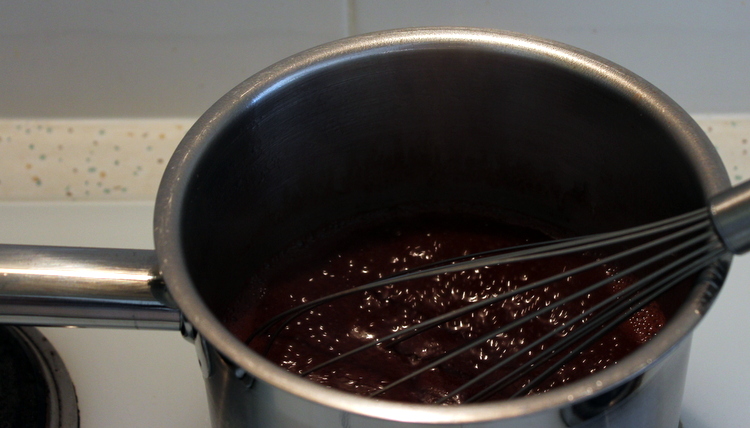
Put all the dry ingredients in a saucepan and whisk until combined.  Gradually add the water and stir well.


Heat on medium heat, stirring until the sauce reaches the boil.  Reduce the heat a little and cook for a about 3 minutes whisking the sauce, making sure the sauce doesn't boil over.  The sauce will thicken up.

Remove from the heat and allow to cool at room temperature.  Strain the sauce through a fine sieve, then stir in the vanilla.  


I keep my chocolate sauce in an empty Bonne Maman jam jar with a screw top lid.  Keep refrigerated, but it won't last long before the kids eat it all.


This recipe comes from food.com and was posted by a guy called Steve_G. (original recipe here)  Steve is a legend because this sauce is the best!  The original recipe uses granulated (white) sugar, and Dutch-processed cocoa, which I've substituted.

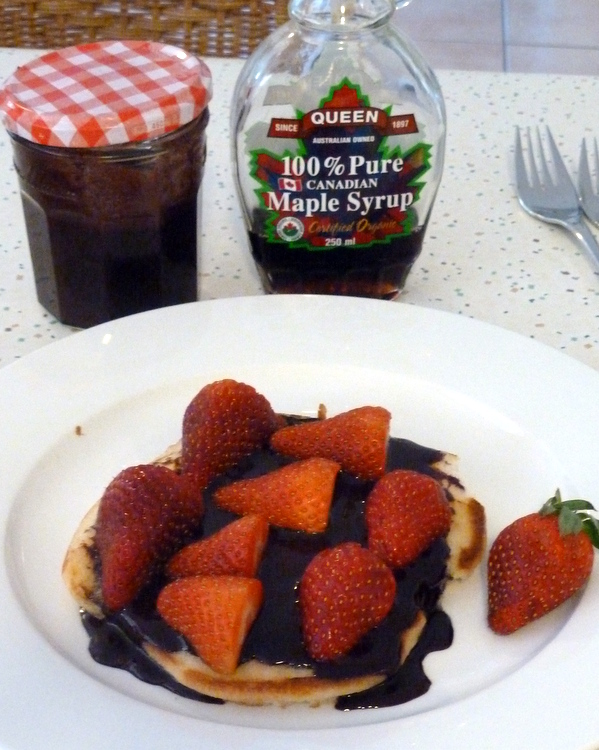
This sauce is great over pancakes, or my kids have it over ice-cream and waffles.  You can use it to make milkshakes, and hot chocolates (I just use non-dairy milk).

This is how my daughter drowns eats her pancakes.

What is Chocolate ?

Okay, this is the simple version.  Cacao beans grow on cocoa trees (botanical name Theobroma Cacao).  These cacao pods or beans are harvested when ripe,  fermented, then dried.  The beans are cracked into small nibs which are roasted to a rich brown colour.  The nibs are ground to form a rich liquid known as chocolate liquor or mass.  This liquid is roughly half cocoa butter (fat) and half cocoa solids (non-fat).  Because of the fat content this liquor solidifies when it cools.  This is called unsweetened or bitter chocolate.  This chocolate mass can be pressed to extract the cocoa butter.  The cocoa solids left are ground into a fine powder known as cocoa powder.  The low-fat content of cocoa powder means it is easier to dissolve into liquids for example, to make hot chocolate.

To make the chocolate, manufacturers use the cocoa butter that was extracted, but it's quite bitter so they add things like sugar, milk and vanilla.  The chocolate is then refined or conched to make it smooth, and tempered to make it glossy and give it crunch or 'snap' when you crack it.

In June, 2009.  Learning how chocolate is made at the Chocolate Museum in Brugge, Belgium.


What is the difference between cocoa powder and Dutch-pressed cocoa powder?

Natural Cocoa powder is acidic.  Dutch-processed cocoa has been treated with an alkali (potasium) to make it Ph neutral.  This makes Dutch-processed cocoa more soluble, richer in colour, and milder or smoother in flavour.  This processing uses high heat which removes a large percentage of the flavonols or anti-oxidants in the cocoa.


What is cocao powder?


Cocao powder (pronounced ka-kow) is made by grinding raw cocao nibs which preserves the anti-oxidants.  It is cold-pressed without solvents.

I buy Raw Cocao powder (see here).  This is what it says on the pack - with over 360% more anti-oxidants than regular cocoa, that's also 14 times more-potent anti-oxidants than red wine, 21 times more than green tea, and 7 times more than dark chocolate.  The problem is of course, that by heating the cocao powder to make the chocolate sauce, I am probably destroying many of the anti-oxidants, but if it starts with more anti-oxidants, it will hopefully still end up with some.

Nutritional Information:  40 grams of cacao powder contains 4.5g of fat, 2.6g saturated fat.  That's for the whole jar of chocolate sauce.  So if you just drizzle a little sauce over a banana for dessert, the fat content is not high.

Resources - The Joy of Baking here.  There is also a good blog post at The Lone Baker here - look at the bottom of the page to understand acidity in baking, and of course David Lebovitz has a great explanation here.


Enjoy the sauce.  It's good.

Sharing at House of Hepworths, It's Overflowing

Friday, 9 November 2012

Fluffy Yummy Pancakes that You Won't Know are Dairy-Free

During the week it's rush, rush, rush in the mornings, but on weekends it's so nice to sit and relax with a hot breakfast and cup of tea.  One of our family favourite's would have to be pancakes.  We make the light fluffy American style pancakes rather than the thin European style.  After becoming dairy-free I would almost cry when I came downstairs to see my family eating pancakes, and I couldn't have any.  Well cry no more.  I have come up with a dairy-free version of pancakes that my whole family enjoys.


Jamie Oliver has a pancake recipe in his book The Ministry of Food, which is super easy to remember - 1 cup of flour, 1 cup of milk and 1 egg.  I like the idea of such a simple recipe that you can just make from memory without having to look up the recipe.  Mine is slightly more complicated, but still simple as there is only 1 of everything.
Ingredients:
1 cup of self-raising (self-rising) flour
1 egg (or I use an egg replacer - see notes)
1 cup of milk - I use almond milk
1 tablespoon white vinegar
1 teaspoon bi-carbonate of soda (baking soda)


Method:
The first step is to make buttermilk.  That is, soured milk.  To do this, add 1 tablespoon of white vinegar (or lemon juice) to your milk, and leave it for 10-15 minutes.  Meanwhile gently heat a frying pan so it's ready.

Place the flour and the extra bi-carb soda in a bowl.  Add the egg and the buttermilk and whisk together.


The batter will be quite runny.  I cook my pancakes in a 20cm/8" non-stick fry pan.  I find this size pan gives me a lovely round shaped pancake.  Make sure the pan is hot (med-high heat) before adding the batter.

Brush the pan with a little macadamia oil (or just use a good non-stick pan), then pour some batter in the pan.  I use a soup ladle which is about half a cup.


Cook until there are lots of bubbles on top of the pancake.  It will look like this


It is now ready to turn over.  This is the fun bit.  Lift the pancake up with a spatula and flip it over.  Sometimes I have a second bigger fry pan on the next burner and just turn the small fry pan upside down over the bigger fry pan.  That way I can start the second pancake while the first one is finishing.


Keep going until you have made all the pancakes.  You will get about 3-4 pancakes from this batter.  Using the soup ladle I get 3.  You can easily double the recipe - it woud just be 2 of everything.  Now top with your favourite pancake topping.


Personally, I can't go past fresh berries with maple syrup and a little icing sugar.


Delicious and you wouldn't know it was dairy free.


What is Maple Syrup?


Maple syrup is the sap from maple trees.  The trees are tapped in spring to remove the sap, which is heated to evaporate the water leaving a concentrated sucrose sap with no colouring or additives.  The Canadian provence of Quebec produces 75% of the world's maple syrup.  Store in the refrigerator once opened.  Beware of maple flavoured syrups which are largely sugar (often high-fructose corn syrup) with added colour and flavourings.   You can learn more about maple syrup at Wikipedia here. 

What is Buttermilk?
Buttermilk used to be the liquid that came churning cream into butter.  Traditionally, to make butter, whole milk would be left to sit for a while so the cream would separate from the milk.  During this time, lactic acid bacteria would grow, fermenting the milk, and giving it a slightly tart, acidic taste. The cream would be churned into butter, and the remaining liquid was buttermilk.  Now buttermilk is made artificially by adding a cultured lactic acid bacteria to homogenized and pasteurized low-fat milk.

According to  Stephanie Alexander in The Cooks Companion, when you use buttermilk in place of milk in a recipe you should add half a teaspoon of bicarbonate soda for every cup of milk, to neutralise the acid in the buttermilk, so the cake/pancake will rise properly.  I've added a whole teaspoon of bicarb soda to this recipe so I get light and fluffy pancakes.

Egg Replacers
Where a recipe calls for eggs, try using:
  • a commercial egg replacer
  • 2 egg whites for every 1 egg
  • 75ml oil or soy yoghurt for 1 egg
  • 1 tablespoon ground flax seeds plus 3 tablespoons water
  • 1 tablespoon cornflour plus 2 tablespoons of water
For a full list of egg replacement ideas see Chef In You here


Related Posts Plugin for WordPress, Blogger...